
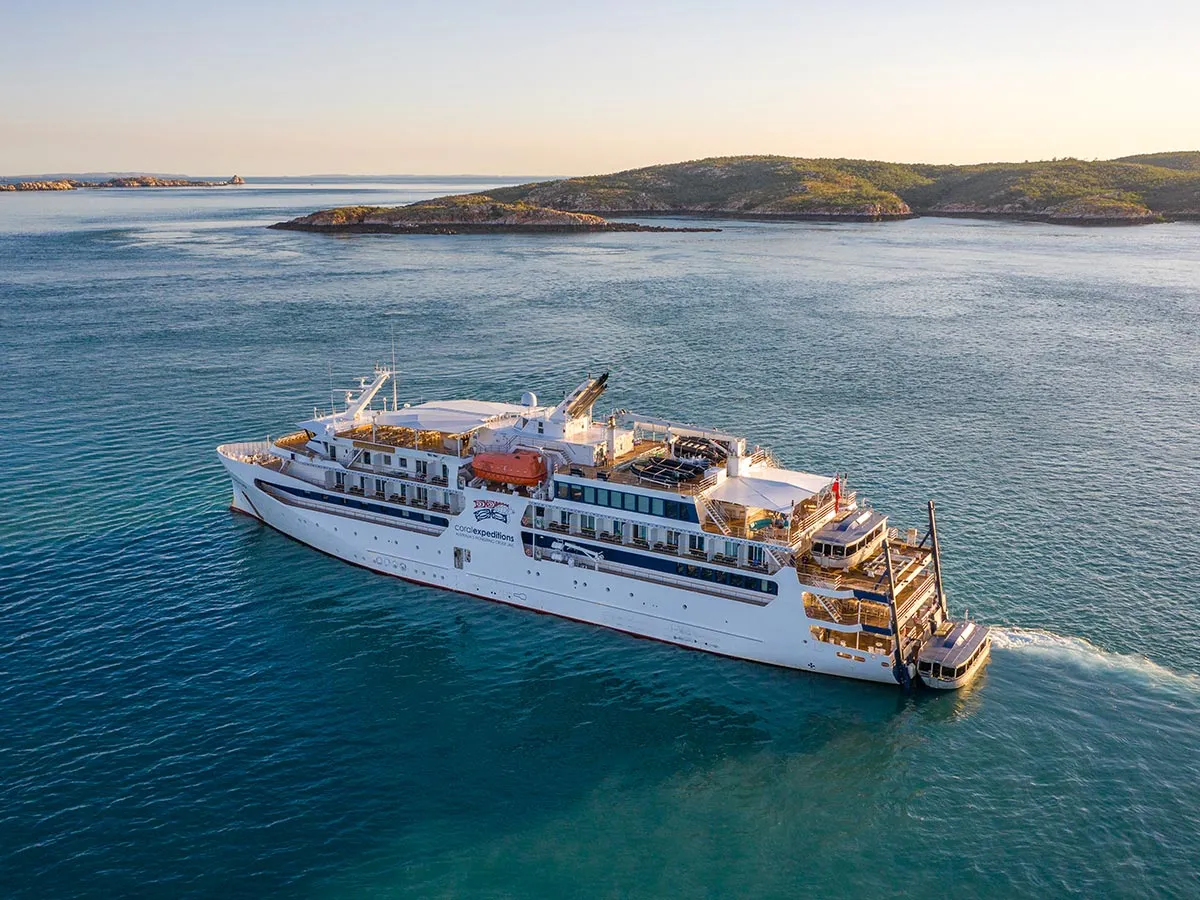
Australia has close to 60,000 kilometres of coastline once you count its islands, and a remarkable share of it has no road access at all. Whole stretches of the Kimberley, the outer reefs off Queensland and the island chains of the Southern Ocean are simply out of reach unless you arrive by water. That’s the quiet appeal of adventure cruises. They trade the resort pool and the tour bus for places most Australians will never see in person.
Adventure cruises in Australia have come a long way from the rugged, bring-your-own-sleeping-bag trips of a generation ago. Today the category spans everything from basic eco-expeditions to polished small ships with private cabins, excellent food and specialist guides. What they share is a focus on getting off the ship and into the landscape: walking, swimming, fishing and exploring by small boat.
If you’re weighing up your first adventure cruise, or trying to work out which region to tackle next, this guide covers what to expect, where to go, when to travel and how to choose a trip that genuinely suits you.
What makes an adventure cruise different?
A conventional ocean cruise is built around the ship. An adventure cruise is built around the destination, and the vessel is the tool that gets you there.
In practice, that usually means:
- Smaller vessels, often carrying dozens of guests rather than thousands, which can anchor in sheltered bays and navigate shallow or narrow waterways.
- Daily excursions by tender or inflatable boat, taking you up rivers, into gorges or across reef flats.
- Guided activities such as bushwalks, snorkelling, fishing and cultural site visits, led by crew who know the region well.
- Flexible itineraries that shift with tides, weather and conditions, rather than a fixed port schedule.
- Fewer formalities. Dress codes are relaxed, evenings are sociable, and days start early.
The best way to think of it is as a moving base camp. You wake up somewhere new, head out to explore after breakfast, and return in the afternoon to a hot shower, a good meal and a comfortable bed. For many travellers, particularly those who love the outdoors but no longer want to camp, it’s the ideal combination.
Where to go: Australia’s standout adventure cruise regions
Each part of the coast has its own character, season and style of adventure. Here’s how the main regions compare.
The Kimberley, Western Australia. For many people this is the benchmark for adventure cruises in Australia. The coast between Broome and Wyndham is ancient, red and deeply dissected, with enormous tides that can exceed ten metres. Highlights often include the tidal rush at Horizontal Falls in Talbot Bay, the reef that appears to rise from the sea at low tide at Montgomery Reef, the waterfalls and escarpments of the Prince Regent and Hunter rivers, and the islands of the Buccaneer Archipelago. The region is also home to rock art of great age and cultural significance, cared for by its Traditional Owners.
The Great Barrier Reef, Queensland. Most visitors see the reef on a crowded day trip. An adventure cruise allows access to outer reefs, sand cays and islands over several days, with multiple snorkelling sessions and far fewer people in the water.
The Rowley Shoals, Western Australia. Three coral atolls roughly 300 kilometres off Broome, with water clarity that divers and snorkellers talk about for years afterwards. It’s remote enough that relatively few vessels make the crossing each season.
The south and south-west coast. From the granite islands of the Recherche Archipelago off Esperance to the rugged shores of South Australia, the southern coast offers cooler-water adventures, sea lion colonies, seabirds and dramatic coastal walking.
Choosing the right adventure cruise in Australia for your style of travel
Not every adventure cruise will suit every traveller, and the variation within the category is larger than most people expect. Before you look at dates, it helps to be clear on a few things.
How active do you want to be? Some itineraries involve daily walks over rough terrain, wet landings and plenty of time in the water. Others are gentler, with more time on board and shorter excursions. Neither is better; it’s about what you’ll enjoy.
How much comfort matters to you? Cabins range from simple bunk rooms with shared facilities to spacious suites with ensuites and windows. Food ranges from hearty to genuinely refined. Be honest about your expectations and check the details, as photos rarely tell the whole story.
What’s the vessel’s size and draft? Smaller, shallow-draft vessels can reach places that larger ships can’t. That access is often the entire point of the trip, so ask which sites the vessel is actually able to visit.
Who are the guides? A good guide turns a pretty view into a story. Ask about the crew’s local experience and whether specialists, such as naturalists or marine biologists, travel on board.
For a sense of the range available, it’s worth browsing a few small-ship adventure cruises around Australia side by side, comparing the regions covered, the length of each itinerary and the activities built into each day.
What a typical day on an adventure cruise looks like
Every trip is different, but many follow a similar rhythm.
Early morning. Coffee on deck as the ship moves into position. Early starts are common because light, temperature and tides are often at their best first thing.
Morning excursion. After breakfast, guests head out by tender. This could be a walk to a waterfall, a snorkel over a fringing reef, a visit to a rock art site with a guide, or a slow cruise up a mangrove-lined creek looking for birdlife.
Midday. Back on board for lunch and a rest while the vessel repositions. In hot northern regions, this is when most people retreat to the shade or their cabin.
Afternoon. A second outing, perhaps fishing, a beach landing or a swim in a freshwater pool (only where the crew has assessed it as safe).
Evening. Sunset drinks, dinner and often a short talk from a guide about the next day’s plans.
Optional extras worth knowing about
Some vessels carry extra equipment for guests who want more. Scenic helicopter flights over remote gorges, heli-fishing trips and diving are offered on certain itineraries, usually as optional activities with an additional cost. These can be extraordinary experiences, but they depend on weather, aircraft availability and the specific trip. If an activity is important to you, confirm in writing whether it’s offered on your chosen departure and whether it’s included in the fare or charged separately.
When to go: timing your adventure cruise
Seasons on the Australian coast vary so widely that timing is often what decides the region for you.
- The Kimberley is cruised during the dry season, roughly April to September. Early in the season waterfalls tend to be fuller after the wet; later in the season the weather is more settled and the days are clearer, though falls may be reduced.
- The Great Barrier Reef is generally at its most comfortable from around June to November, with drier weather and fewer marine stingers than the northern summer.
- The Rowley Shoals have a short season, typically in the spring months, when sea conditions are calmer.
- The southern coast is better suited to summer, when the Southern Ocean is at its gentlest.
Nature doesn’t follow a timetable, so treat wildlife and weather as possibilities rather than certainties. A migrating whale or a school of manta rays is a bonus, not something any responsible operator can promise.
Preparing for your first adventure cruise
A little preparation goes a long way.
- Check the fitness requirements. Getting in and out of small boats, walking on rocky ground and climbing ladders are common. If you have mobility concerns, raise them with the operator before booking.
- Pack for the conditions. Lightweight long sleeves, a wide-brimmed hat, reef-safe sunscreen, polarised sunglasses and sturdy shoes that can get wet are essentials in the north. Bring warmer layers for the south.
- Understand the inclusions. Meals and guided excursions are often included; drinks, national park or visitor fees, flights to the departure port and optional activities may not be. Ask for the full list.
- Read the booking conditions. Remote-area travel is weather-dependent, so understand the itinerary-change and cancellation terms before you pay.
- Consider travel insurance. Make sure your policy covers remote areas and any activities you plan to do.
- Be ready to disconnect. Mobile coverage disappears quickly on the remote coast. Many travellers find that’s one of the best parts of the trip.
Respecting the places you visit
Many of the most remarkable places on adventure cruises in Australia are culturally significant sites, national parks or marine reserves. Visiting them is a privilege. Follow your guides’ instructions, stay on marked paths, don’t touch rock art, and take nothing but photographs. In the north, remember that saltwater crocodiles are present, so only swim where your crew has specifically said it’s safe. Travelling lightly helps keep these places as extraordinary for the next visitors as they were for you.
Mistakes first-timers often make
Most disappointing adventure cruises aren’t bad trips. They’re good trips booked by the wrong person, or at the wrong time. A few common missteps are worth avoiding.
Choosing on price alone. Two itineraries can look similar and differ enormously in what’s included, how many guests are on board and how much time you’ll actually spend off the ship. Compare what each day involves, not just the fare.
Underestimating the heat. In the tropical north, even the dry season can be hot in the middle of the day. Itineraries are usually structured around this, but it’s worth knowing before you go, especially if you don’t handle heat well.
Overpacking. Cabins on small vessels are compact, and you’ll spend most of your time in the same few comfortable, practical outfits. Soft luggage is far easier to stow than hard cases.
Expecting a fixed timetable. On the remote coast, tides and weather decide a great deal. An itinerary that changes on the day is usually a sign of a crew putting safety and conditions first, not of something going wrong.
Booking too late. Popular regions and peak months can fill well ahead, particularly on smaller vessels with limited cabins. If you have a specific season or itinerary in mind, it pays to plan early.
Skipping the pre-departure information. Operators often send detailed notes on what to pack, what to expect and how to reach the embarkation port. Read them properly. They answer most of the questions people end up asking on day one.
Final thoughts
Adventure cruises are one of the few ways to see Australia’s most isolated coastline without giving up comfort. They suit curious travellers who would rather spend the day walking to a waterfall or snorkelling a remote reef than lying by a pool, and who appreciate returning each evening to a good meal and a proper bed.
The key is choosing well. Pick a region and season that match what you want to see, be realistic about your fitness and comfort needs, and ask plenty of questions about what’s included and how the itinerary might change. Do that, and an adventure cruise can show you a side of Australia that very few people ever experience.