
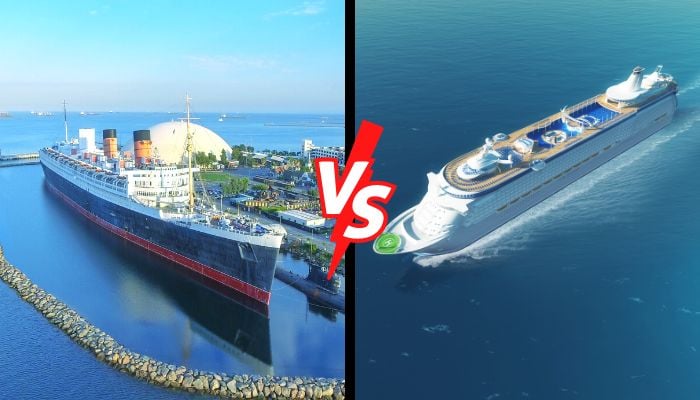
To the untrained eye, a massive passenger vessel gliding into a harbor appears to be just that: a cruise ship. In casual conversation, the terms ocean liner and cruise ship are often used interchangeably to describe any large sea-going vessel that carries passengers. To naval architects, maritime historians, and seasoned sailors, however, these two types of ships are fundamentally different machines engineered for entirely different purposes.
The confusion is understandable given that both vessel types carry hundreds or thousands of people across open water and feature multiple decks, dining rooms, and passenger accommodations. The core distinction lies in their primary mission. An ocean liner is built for point-to-point transportation across rough ocean basins on a strict schedule, regardless of weather. A cruise ship is designed as a floating resort destination, created for leisure, warm-weather sightseeing, and round-trip voyages in relatively calm waters.
Historical Evolution of Passenger Vessels
Understanding the structural and operational differences between these vessels requires looking at how passenger shipping evolved over the past two centuries.
The Era of the Ocean Liner
Before the advent of commercial transoceanic aviation in the mid-twentieth century, ocean liners were the only viable means of international transportation across major bodies of water, particularly the North Atlantic. These ships carried mail, trade goods, diplomatic correspondence, immigrants, and wealthy travelers between specific ports, such as Southampton and New York.
Because these vessels operated year-round, they had to battle some of the most treacherous marine environments on Earth, including winter North Atlantic gales, massive rogue waves, and freezing spray. Reliability and speed were paramount. A delayed arrival meant broken mail contracts, missed train connections, and severe financial penalties for the shipping line. Ships like the Queen Mary, the Normandie, and the United States were built with brute strength, knife-like hulls, and powerful engines capable of maintaining high speeds through heavy seas.
The Rise of the Cruise Ship
By the late 1950s and 1960s, long-distance jet airliners like the Boeing 707 revolutionized global travel. Crossing the Atlantic by air took hours rather than days, drastically undercutting the passenger base of traditional ocean liners. Facing bankruptcy, maritime companies pivoted. Instead of selling transportation from point A to point B, they began selling the journey itself as a vacation experience.
This shift gave birth to the modern cruise industry. Rather than fighting rough ocean winter storms to deliver passengers to a cold European port, ships were deployed to warm, calm regions like the Caribbean and the Mediterranean. Speed and extreme heavy-weather durability were no longer primary engineering requirements. Instead, onboard space, guest comfort, leisure amenities, and fuel efficiency became top priorities.
Hull Design and Structural Engineering
The most significant physical differences between an ocean liner and a cruise ship reside below the waterline and within the structural framework of the hull itself.
Hull Shape and Draft
An ocean liner features a deep, long, and narrow hull with a sharp V-shaped bow. This streamlined profile allows the ship to slice cleanly through heavy swells rather than pounding against them. The deep draft—the distance between the waterline and the bottom of the hull—provides low centers of gravity and exceptional stability in rough seas.
In contrast, a modern cruise ship is built with a wide, boxy hull profile that maximizes interior volume. The bow is flatter and shorter, as the ship rarely needs to punch through thirty-foot Atlantic waves at high speed. The draft of a cruise ship is intentionally shallow, often between 25 and 30 feet, allowing the vessel to enter shallow tropical harbors, small island ports, and narrow channels that an ocean liner could never access.
Steel Thickness and Freeboard
Operating in severe ocean conditions requires immense structural reinforcement. Ocean liners are built with exceptionally thick high-tensile steel plating along the hull and superstructure to resist the twisting, flexing, and slamming forces caused by severe waves.
An ocean liner also features a high freeboard, which is the height of the ship’s side between the waterline and the main deck. A high freeboard, combined with an enclosed bow section, keeps green water from breaking over the front of the ship and damaging passenger spaces.
Cruise ships, by comparison, use thinner steel plating to reduce overall weight and maximize fuel economy. Because they operate predominantly in fair weather and avoid major storm systems whenever possible, they do not require extreme structural armor. Cruise ships feature large open glass expanses, outdoor promenade decks, and balconies positioned lower to the waterline to enhance sea views for guests.
Speed, Power, and Propulsion
The operational goals of each vessel dictate their propulsion systems and engine capacities.
High Speed vs. Fuel Efficiency
Ocean liners were engineered for raw speed. Crossing thousands of miles of open ocean on a fixed weekly timetable meant maintaining cruising speeds between 26 and 30 knots, with maximum speeds pushing past 30 to 35 knots. Achieving these speeds through deep water required massive engine plants, expansive fuel capacities, and deep-set propellers.
Cruise ships prioritize fuel efficiency over top speed. Most modern cruise ships operate at comfortable cruising speeds between 18 and 21 knots, slowing down even further during overnight transits between nearby islands or coastal ports. High speeds burn exponentially more fuel, which increases operating costs and carbon emissions without adding value to the passenger vacation experience.
Manoeuverability in Port
Because ocean liners historically docked at major deep-water piers assisted by tugboats, extreme independent harbor maneuverability was a secondary concern.
Modern cruise ships are designed to operate independently in tight harbors without relying on tugboat availability. They utilize sophisticated azimuth thrusters—podded propulsion units mounted beneath the stern that rotate 360 degrees—combined with powerful bow thrusters. This allows a massive cruise ship to move sideways, pivot on its own length, and dock smoothly even in tight island berths.
Superstructure and Passenger Space Allocation
The silhouette of a passenger ship reveals its internal layout and design priorities.
The Floating Resort Concept
Cruise ships are often described as floating hotels or resort complexes. Their tall, blocky superstructures rise many stories above the waterline to maximize floor space for passenger cabins, specialty restaurants, water parks, theaters, casinos, and open-air sun decks. The focus is inward and upward, creating vast vertical atrium spaces and sprawling entertainment venues.
The Ocean Liner Architecture
Ocean liners present a lower, sleeker profile to reduce wind resistance and lower the vessel’s center of gravity. Passenger public rooms on classic liners were housed deep within the superstructure to shield guests from heavy weather and sea spray. Windows were smaller and heavily reinforced against storm damage. Outdoor deck space was often enclosed with heavy glass screens to protect passengers from biting ocean winds during high-speed transits.
Modern Exceptions and Current State of the Fleet
Today, the ocean liner is a nearly extinct species of passenger vessel. Almost every new passenger ship constructed around the world is built strictly as a cruise ship.
The sole remaining purpose-built ocean liner operating in regular transatlantic service is Cunard Line’s Queen Mary 2, ocean-launched in the early 2000s. Engineered specifically to carry on the legacy of classic transatlantic crossings, Queen Mary 2 features a heavy steel hull, a deep draft, extra-thick plating, a long sharp bow, and powerful engines capable of reaching 30 knots. She routinely crosses the North Atlantic between Southampton and New York in conditions that would cause standard cruise ships significant operational discomfort.
Frequently Asked Questions
Can a modern cruise ship cross an ocean safety?
Yes, modern cruise ships perform oceanic crossings regularly, such as seasonal repositioning cruises between Europe and the Caribbean. While they possess advanced weather routing technology and stabilizers to ensure safe transit, they must navigate at lower speeds, actively bypass major storm tracks, and provide a less comfortable ride in severe sea conditions compared to a dedicated ocean liner.
Why do ocean liners have a higher ticket cost per night than standard cruise ships?
Ocean liners require significantly higher operational costs due to greater fuel consumption at higher speeds, heavy structural maintenance, specialized hull designs, and lower passenger density relative to overall ship size. Furthermore, dedicated transatlantic ocean liners cater to a traditional luxury market that includes formal dining and elevated service ratios.
Do ocean liners still carry commercial cargo and international mail?
While classic ocean liners relied heavily on government mail contracts and high-value cargo holds for revenue, modern passenger transportation has largely split from cargo operations. Dedicated container ships handle global cargo and mail transport, leaving remaining passenger vessels like the Queen Mary 2 to carry minimal specialized freight, such as personal vehicles or household goods for relocating passengers.
How do roll stabilizers work on ocean liners versus cruise ships?
Both types of vessels utilize active fin stabilizers, which are wing-like structures that extend horizontally from the lower hull into the water to counteract rolling motion caused by waves. On ocean liners, these fins are designed to operate effectively at high cruising speeds in deep ocean swells, whereas cruise ship stabilizers are optimized for lower cruising speeds and can even operate using zero-speed technology while at anchor.
Why are cruise ship bows shaped differently than ocean liner bows?
An ocean liner features an elongated, knife-like bow designed to cut through heavy Atlantic waves and push water away from the ship’s superstructure. Cruise ships typically utilize an axe bow, bulbous bow, or inverted bow shape optimized for fuel efficiency, reducing wave-making resistance in calm to moderate seas rather than cutting through massive oceanic storm swells.
Is the Queen Elizabeth 2 an ocean liner or a cruise ship?
The Queen Elizabeth 2, often called the QE2, was constructed as a dual-purpose vessel in the late 1960s. She was built with the heavy hull strength, speed, and deep draft of an ocean liner for North Atlantic crossings during the summer, but designed with a slightly lower draft and flexible layout so she could operate as a cruise ship in warmer waters during the winter months.
Will more ocean liners ever be built in the future?
It is highly unlikely that major maritime companies will build new ocean liners in the future due to high construction costs and specialized operational limitations. Transatlantic air travel remains vastly faster and cheaper for point-to-point transportation, making the low-speed, leisure-focused cruise ship model far more profitable for the modern maritime industry.